

Pick the wrong affiliate commission model and you'll spend months wondering why a program that looked good on paper is quietly bleeding margin. You're paying affiliates, players are coming in, but the economics just don't add up.
It's one of the most common (and most fixable) problems in online casino affiliate marketing. The model you choose determines how risk is shared, how affiliates behave, and how competitive your program is when partners are comparing you to other operators.
This guide walks through CPA, RevShare, and Hybrid deals in plain terms: what each one actually means, when each one makes sense, and how to build a structure that works for your platform rather than against it.
What Is an Affiliate Commission Model?
%20(1).avif)
An affiliate commission model is the agreement that defines how you pay your affiliate partners for the players they refer to your platform. It's the structure that shapes the incentives on both sides of the relationship.
In affiliate marketing broadly, commission structures vary significantly by industry, but iGaming has its own conventions. Here, the model you choose has a direct effect on your cost per acquisition, your long-term liabilities, and the quality of traffic your affiliates are motivated to send.
There are three models that cover the vast majority of deals in the market:
- CPA (Cost Per Acquisition): A fixed, one-time fee per qualifying player
- RevShare (Revenue Share): An ongoing percentage of the net revenue a player generates
- Hybrid: A reduced CPA combined with an ongoing RevShare percentage
None of them is universally best. Each one fits different operator profiles, different affiliate types, and different stages of program maturity.
CPA: Pay Once, Move On
%20(1)%20(1).avif)
CPA is the simplest model to understand. An affiliate refers a player who meets your qualifying criteria (typically a minimum deposit, sometimes a minimum number of rounds played) and you pay the affiliate a flat fee. Deal done.
Rates vary considerably depending on the market, the player's geography, and the affiliate's traffic quality. In competitive iGaming markets, CPA rates for quality affiliates can range from around $100 to well over $400 per player.
Why operators reach for CPA
Predictability. You know your acquisition cost before a single player logs in, which makes budgeting and margin forecasting clean. For newer operators, or those entering unfamiliar markets without solid player lifetime value (LTV) data, that certainty has real value.
It also limits your long-term liability. Once the CPA is paid, future revenue from that player belongs entirely to you. If they become a high-value customer, you've made a profitable acquisition. If they churn in week two, at least you know exactly what you lost.
Where CPA gets risky
The risk flips to your side when it comes to traffic quality. Affiliates get paid whether or not the player sticks around, which creates an incentive mismatch. Without strong qualifying criteria and solid fraud detection in your affiliate management platform, CPA programs attract low-intent traffic: players who sign up once, grab a welcome bonus, and disappear.
Affiliate fraud is one of the persistent challenges in performance marketing, and CPA programs are particularly exposed without the right safeguards in place.
RevShare: Long-Term Alignment, Long-Term Commitment
%20(1).avif)
RevShare works differently. Instead of a one-time payment, you share a percentage of the net revenue each referred player generates, paid on an ongoing basis for as long as that player is active on your platform.
Typical RevShare rates in online casino affiliate marketing sit somewhere between 20% and 45%, though top-tier partners often negotiate outside that range. Net revenue usually means gross gaming revenue minus bonuses, fraud chargebacks, and sometimes payment processing fees. The exact definition should always be spelled out clearly in your deal terms.
The genuine appeal of RevShare
The alignment. When an affiliate earns a cut of ongoing revenue, they're financially motivated to send you players who actually play, not just sign up. High-quality, long-retained players are good for both of you. That's a much healthier incentive structure than CPA, where the affiliate's job ends at the deposit confirmation.
For operators with strong retention and a clear picture of player LTV, RevShare can be significantly cheaper per player over a 12-month horizon than the equivalent CPA deal. Affiliate-driven acquisition is one of the higher-ROI channels when models are structured correctly.
The complications
RevShare creates ongoing liabilities that can be hard to forecast. A handful of high-volume affiliates on strong RevShare deals can represent a meaningful monthly commitment regardless of how the rest of your business is performing.
There's also the negative carryover question. If a player wins big in a given month and generates negative revenue for you, does that loss carry forward and reduce the affiliate's future commissions? How you define this, and how clearly you define it upfront, will determine how many affiliate disputes you end up managing.
Hybrid: Sharing the Risk, Sharing the Upside

Hybrid deals split the difference. You pay a reduced upfront CPA alongside an ongoing RevShare percentage: something like $100 CPA plus 20% RevShare, rather than a $300 pure CPA or a 35% pure RevShare.
The logic is straightforward. The affiliate gets immediate compensation for the work of acquiring a player, while you retain more long-term upside than a pure RevShare deal would allow. Both parties have skin in the game on both ends.
Hybrid structures are increasingly common in the igaming affiliate software landscape, particularly for established affiliates who want some immediate return without giving up their long-term revenue participation. Hybrid deals have become a preferred structure for high-volume content publishers in iGaming precisely because of this dual incentive.
The downside is complexity. Hybrid deals require accurate tracking of both the CPA qualification event and ongoing revenue attribution. Without robust reporting, the admin overhead can become significant, especially as your program scales. This is where the quality of your igaming affiliate platform matters most.
CPA vs RevShare vs Hybrid: Side by Side
6 Factors That Should Shape Your Commission Model Choice
%20(3)%20(1).avif)
There's no shortcut here. The right model depends on your specific situation. But these are the factors worth working through before you lock anything in:
- Your player LTV data. If you don't have reliable data on how long players stay and how much they generate, you're guessing on CPA pricing. RevShare requires even more confidence in your numbers. Build this picture first.
- Your retention performance. Strong retention makes RevShare attractive over time; it rewards you for keeping players engaged. Weak retention makes CPA safer because your costs are capped regardless of churn.
- The type of affiliate you're dealing with. SEO affiliates with evergreen content tend to deliver consistent, long-horizon traffic. They're natural RevShare partners. PPC affiliates running short campaign bursts are often better suited to CPA, where the economics are clear-cut.
- Your market maturity. Entering a new or uncertain market with limited player behavior data makes CPA the lower-risk starting point. You can revisit the model once you have enough data to price RevShare confidently.
- Your fraud exposure. Markets and traffic sources with higher fraud risk often favor RevShare, since payment is tied to actual revenue generation rather than just a qualifying action.
- What your best affiliates actually want. The affiliates driving the most value often have preferences. Flexibility (the ability to offer CPA to one partner and Hybrid to another) can be the deciding factor in signing high-quality partners your competitors are also chasing.
Structuring Commission Tiers That Scale With Your Program
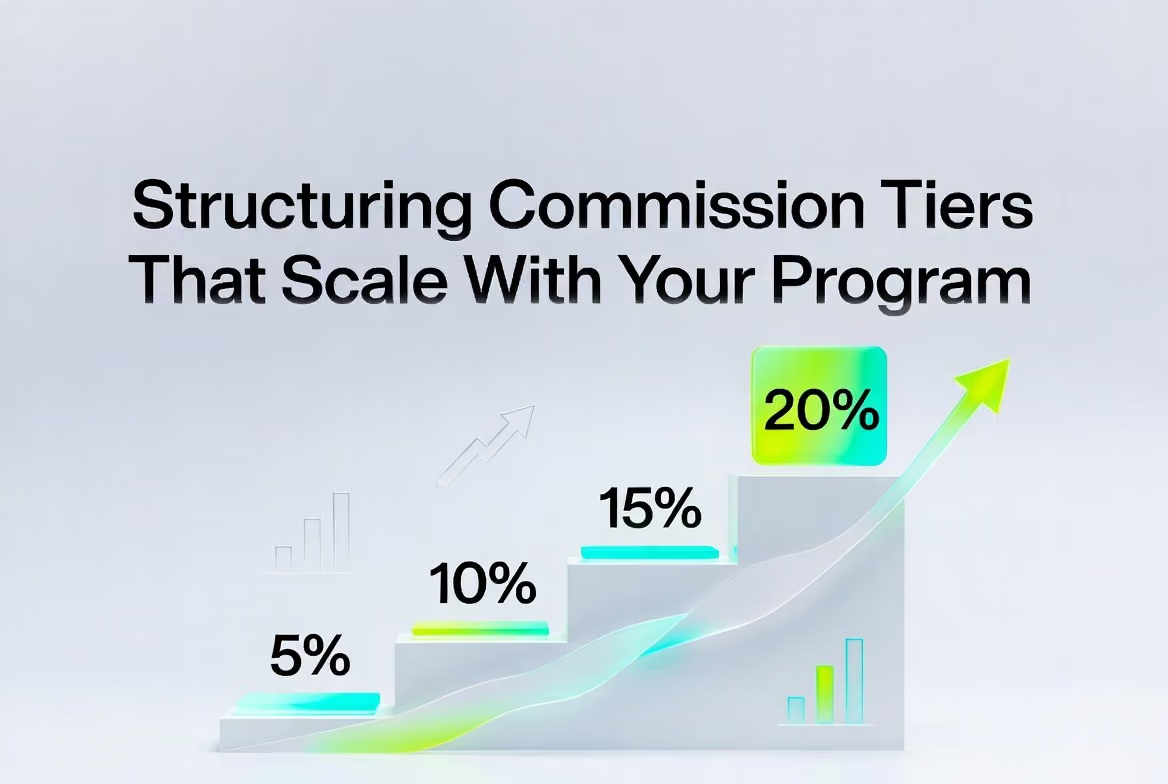
Choosing a base model is step one. Building a tiered structure that evolves as affiliates prove their value is where the real leverage is.
Start with a defensible baseline
Your default deal is what new, unproven affiliates start on. It doesn't need to be your best offer. It just needs to be competitive enough to attract partners worth working with. Set it based on your LTV data, not what you hope a player might be worth.
Build in performance-based progression
As affiliates demonstrate consistent traffic quality, they should unlock better terms: higher RevShare percentages, increased CPA rates, or additional bonuses. Tiering gives affiliates a clear incentive to grow with your program, and it protects you from locking in generous terms before you have evidence of performance.
Use your real-time affiliate tracking data to review tier eligibility regularly rather than relying on annual manual reviews. Monthly or quarterly checks keep your structure responsive.
Negotiate custom deals for your top-tier partners
Your highest-volume, highest-quality affiliates should never be sitting on a standard deal. A custom affiliate commission model built around their specific traffic profile and your platform's data is worth the overhead. Some of your best ROI partnerships will come from arrangements that don't match any standard template.
Build review cycles into every deal
A RevShare rate that was competitive 18 months ago might be well above or below market today. Review active deals on a defined schedule: annually at minimum, quarterly for high-volume partners. Treat the conversation as a normal part of the relationship rather than an awkward renegotiation.
Mistakes Operators Make With Affiliate Commission Models

Most commission model problems aren't caused by choosing the wrong model. They're caused by executing the right one carelessly. Here's where things tend to go wrong:
- Pricing CPA without player LTV data. Setting a CPA rate based on gut feel or general benchmarking without your own LTV numbers is a reliable way to either overpay or underprice your program.
- Leaving negative carryover undefined. In RevShare deals, not specifying how you handle player winning months creates expensive disputes that damage affiliate relationships.
- Weak qualification criteria on CPA. A low deposit threshold and no further checks is an open invitation to low-quality, incentivised traffic. Define exactly what constitutes a qualifying player.
- Treating all affiliates identically. A high-volume SEO publisher and a small niche review site have completely different traffic profiles. One-size deals underserve your best partners and overpay your weakest ones.
- Inconsistent reporting. Affiliates lose trust fast when their dashboards show different numbers than their commission statements. Accurate, real-time reporting across CPA, RevShare, and Hybrid deals simultaneously is the baseline expectation.
- Letting old deals run unreviewed. A RevShare deal that's been running for three years without review is almost certainly out of step with your current economics, your current market, or both.
How TheAffiliatePlatform Handles All Three Models

The commission model conversation only matters if your platform can actually execute it accurately. And that's where a lot of programs quietly fall apart. Not because of bad deal design, but because the tracking, reporting, and payment infrastructure can't keep up.
TheAffiliatePlatform is a SaaS affiliate management solution built by the founders of Smartico.ai, and it’s specifically for iGaming operators. It handles CPA, RevShare, and Hybrid deals in the same system, with real-time tracking and analytics so your commission calculations are always working from accurate, up-to-date data rather than end-of-month reconciliations.
The custom deal structure tools are particularly relevant here. You can build bespoke commission arrangements for individual affiliates without creating a reporting or accounting mess. Everything feeds into the same dashboard. The multi-level affiliate network building capability means you can run tiered programs at scale, with performance data at each level informing tier reviews and deal adjustments.
Payment management handles commission payouts across multiple deal types without manual reconciliation. And if you're running A/B tests on landing pages or creative assets (useful for understanding what actually converts your affiliate traffic), the built-in media tools handle that without needing separate software.
If you're setting up a new program or auditing an existing one, seeing how the platform handles your specific commission structure is worth 30 minutes. Book a demo with TheAffiliatePlatform and walk through your requirements directly.
FAQ
What's the difference between CPA and RevShare in affiliate marketing?
CPA pays affiliates a single flat fee for each qualifying player they refer. RevShare pays affiliates a percentage of the ongoing revenue that player generates for as long as they remain active. CPA gives operators predictable acquisition costs; RevShare aligns long-term incentives around player quality. The right choice depends on your player LTV data, your retention performance, and how much financial risk you want each side to carry.
When does a Hybrid affiliate deal make more sense than a pure CPA or RevShare?
Hybrid deals work best with established, trusted affiliates driving consistent, high-quality traffic. The upfront CPA covers the affiliate's immediate acquisition effort, while the RevShare component keeps them invested in player quality long-term. If you're working with a high-volume publisher or a large comparison site that wants both guaranteed income and revenue participation, a Hybrid structure is worth putting on the table.
How do you reduce fraud risk in a CPA affiliate program?
Define precise qualifying criteria (minimum deposit amounts, geo restrictions, verified account requirements) and make sure your affiliate management platform tracks these in real-time. Watch for patterns like high volumes of single-deposit players, clustered sign-ups from the same IP ranges, or unusually low post-deposit engagement. Gambling Insider regularly covers fraud patterns in iGaming affiliate programs, and the consensus is that platform-level detection is more reliable than manual review.
Can you change your affiliate commission model after the program is already running?
You can update your default deal for new affiliates at any time. Changing terms for existing affiliates requires renegotiation, and doing it without warning is a reliable way to damage relationships. If adjustments are necessary, give affiliates advance notice, explain the reasoning clearly, and offer a transition period. Affiliates who understand why terms are changing are significantly more likely to stay in the program.
What RevShare percentage is typical in online casino affiliate marketing?
In online casino affiliate marketing, RevShare percentages typically range from 20% to 45%, with 25-35% being the most common range for mid-tier affiliates. Top-performing affiliates often negotiate higher rates. The right number depends on your player LTV, your operational costs, and competitive conditions in your target markets. There's no single standard, which is exactly why having flexible commission deal tools in your platform matters.
Where to Go From Here
Choosing the right affiliate commission model comes down to three things: knowing your numbers, understanding your affiliates' incentive structures, and having a platform that executes deals accurately at scale. CPA, RevShare, and Hybrid each have a place. The mistake is defaulting to one without thinking through the fit.
Start with your LTV data, match your model to how your affiliates operate, and build review cycles in from day one. If you need an igaming affiliate platform that handles all three models without adding operational complexity, explore TheAffiliatePlatform or book your free, in-depth demo to see it in action.
Did you find this article helpful? If so, consider sharing it with other industry professionals such as yourself.
Related Guides:
Need help?
Lets have a chat!
Lets have a chat!
We're here to help you understand how our platform can meet your needs. Schedule a meeting with us, and let's explore how we can drive your success together.
Book a meeting
