
So one of your affiliates just promised players a "guaranteed win" on a slots promo. You didn't tell them to. You didn't even know about it until a regulator did. And now it's your problem.
That's the thing about affiliate marketing compliance in iGaming. The mistakes aren't always yours, but the liability often is. If you run an affiliate program for an online casino or sportsbook, the people promoting your brand are an extension of it, and regulators increasingly treat them that way.
This guide walks through what compliance actually means for iGaming affiliate programs in 2026, where the real risks sit, and how to keep your program clean without strangling the growth that made you start it in the first place. No legal jargon dumps. Just the stuff you need to know.
What "Compliance" Really Means for an Affiliate Program
Affiliate marketing compliance is the set of rules, controls, and checks that keep the marketing done *on your behalf* within the law and within your license conditions. In most other industries that mostly means truth-in-advertising and disclosure. In iGaming it goes a lot further, because gambling is one of the most heavily regulated things you can advertise.
Three layers stack on top of each other:
- Advertising law: the general rules about not misleading people, that apply to any marketing anywhere.
- Gambling-specific regulation: license conditions set by bodies like the UK Gambling Commission, the Malta Gaming Authority, and a growing list of national regulators. The specifics differ by market and change regularly, so the exact rules below are illustrated with the UK as a worked example. [Verify: confirm the equivalent rules for each market you publish into before relying on specifics.]
- Responsible gambling obligations: rules about protecting vulnerable players, age verification, and not targeting minors or self-excluded users.
Your affiliates touch all three, usually without thinking about any of them.
Why Operators Carry the Risk
Here's the uncomfortable bit. In most regulated markets, the operator holds the license, so the operator answers for how the brand gets marketed, including by third parties. An affiliate running a non-compliant ad is, in the regulator's eyes, often the same as you running it.
That means an affiliate who:
- promises unrealistic winnings,
- fails to include responsible gambling messaging,
- runs ads that could reach under-18s, or
- markets in a country where you aren't licensed,
can land *you* with the warning, the fine, or worse. The UK shows how directly this can apply: the Gambling Commission's License Conditions and Codes of Practice make licensees responsible for the actions of third parties acting on their behalf, and the advertising codes (CAP and BCAP) explicitly cover marketing by affiliates acting for an operator. In other words, in the UK an affiliate's non-compliant ad is treated as the operator's responsibility. Most regulated markets follow a similar principle, though the detail varies. [Verify: confirm the equivalent position in each of your other markets with compliance counsel.]
This is why "we didn't know" stopped being a defense a long time ago. Regulators expect you to know.
The 7 Most Common Compliance Failures in iGaming Affiliate Programs
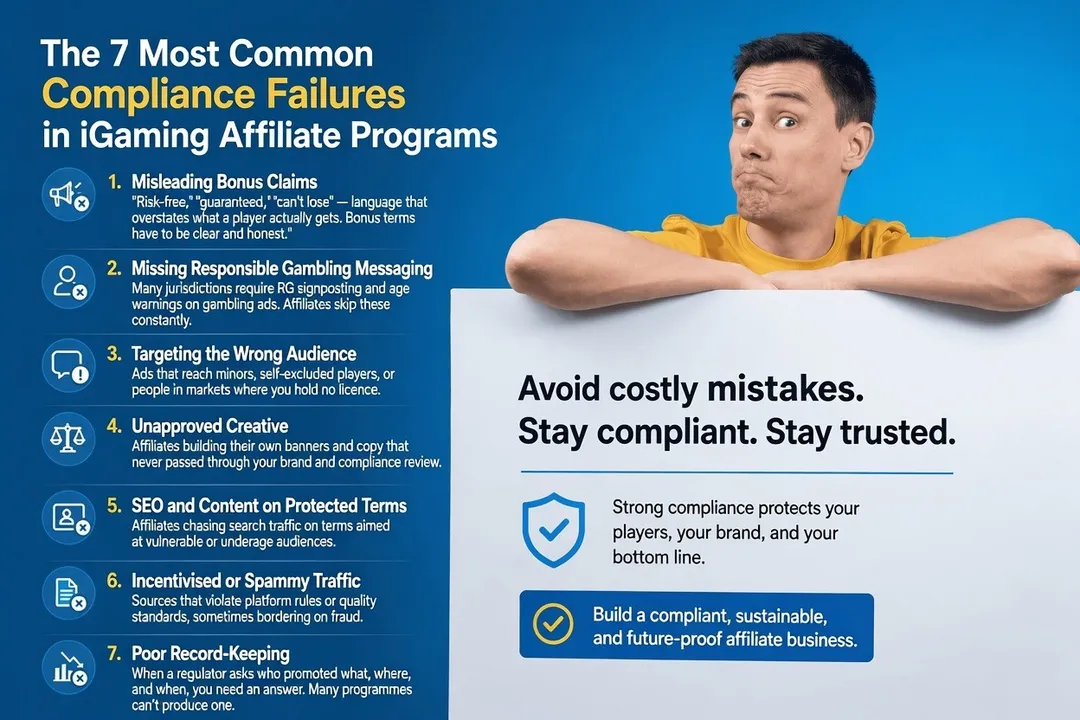
Let's get specific. These are the issues that come up again and again:
- Misleading bonus claims. "Risk-free," "guaranteed," "can't lose": language that overstates what a player actually gets. Bonus terms have to be clear and honest.
- Missing responsible gambling messaging. Many jurisdictions require RG signposting and age warnings on gambling ads. Affiliates skip these constantly.
- Targeting the wrong audience. Ads that reach minors, self-excluded players, or people in markets where you hold no licence.
- Unapproved creative. Affiliates building their own banners and copy that never passed through your brand and compliance review.
- SEO and content that ranks for protected terms. Affiliates chasing search traffic on terms aimed at vulnerable or underage audiences.
- Incentivized or spammy traffic. Sources that violate platform rules or quality standards, sometimes bordering on fraud.
- Poor record-keeping. When a regulator asks who promoted what, where, and when, you need an answer. Many programs can't produce one.
Notice how many of these are about *visibility*: you can't fix what you can't see.
How to Keep a Program Compliant
Compliance isn't a document you write once, but an ongoing operating habit. The programs that stay clean tend to do these things:
- Set the rules in writing, clearly. Your affiliate terms should spell out what's allowed, what's banned, and what happens if someone breaks the rules. Plain language beats legalese nobody reads.
- Pre-approve creative. Give affiliates ready-made, compliant banners and copy, and require approval for anything they make themselves.
- Monitor continuously. Spot-check where your links appear and what's being said around them. Automated monitoring beats once-a-quarter manual reviews.
- Geo-control your traffic. Make sure affiliates can only promote you in markets where you're licensed, and block the rest at the tracking level.
- Keep an audit trail. Log who joined, what they agreed to, which creatives they used, and where their traffic came from.
- Act fast on breaches. A clear, enforced process for warnings, suspensions, and removals. Affiliates respect programs that enforce.
- Train your affiliates. Many breaches are ignorance, not malice. A short onboarding on the rules prevents a lot of pain.
Where a Proper Affiliate Platform Fits in

Most compliance failures trace back to the same root cause: operators can't see what their affiliates are doing at scale, and can't control it from one place. Spreadsheets and email don't cut it once you have more than a handful of partners.
This is where TheAffiliatePlatform earns its keep. Built by Mobius Solutions Ltd for the iGaming world specifically, it brings the whole program into one system, which is exactly what compliance needs. Real-time tracking shows you where traffic is genuinely coming from, so geo-breaches and dodgy sources surface quickly. Custom deal setups and APIs let you encode your rules into how the program runs, rather than hoping affiliates remember them. Media tools and A/B testing mean you can supply pre-approved, compliant creative instead of leaving partners to freestyle. And centralized payment handling and support give you the clean audit trail regulators ask for.
None of this makes compliance automatic because you still need the policies and the people. But it turns compliance from a guessing game into something you can actually see, control, and prove. That's the difference between a program that scales safely and one that's an enforcement action waiting to happen.
FAQ
Who is responsible if an affiliate breaks gambling advertising rules?
In most regulated markets the licensed operator carries primary responsibility for marketing done on its behalf, including by affiliates. In the UK, for example, this is set directly in the Gambling Commission's License Conditions and Codes of Practice, and the advertising codes apply to affiliate marketing as if the operator ran it. The detail differs by market, so confirm the position where you operate. That's why monitoring and clear affiliate terms matter so much.
Do affiliates need to include responsible gambling messaging?
In many regulated markets, yes. In the UK, the advertising codes require gambling marketing to be socially responsible, and safer gambling messaging and age-protection rules apply to affiliate and influencer marketing just as they do to the operator's own ads. The specifics differ by market, so check the rules for each territory you operate in.
Can I be fined for an affiliate's mistake?
Potentially, yes. Because the operator typically answers for how the brand is marketed, a serious affiliate breach can result in action against the operator. Strong oversight is your best protection.
What's the easiest way to monitor affiliate compliance?
Centralized, real-time tracking through a dedicated affiliate platform. It surfaces where your traffic comes from and where your links appear, which is most of the compliance battle. Manual, occasional checks miss too much.
How often should I review my affiliate program for compliance?
Continuously, not periodically. Rules change, affiliates change tactics, and new markets bring new obligations. Ongoing automated monitoring plus regular formal reviews is the realistic standard.
Final Words
Affiliate marketing compliance in iGaming comes down to one idea: you're accountable for marketing you didn't personally do. The operators who handle it well don't rely on trust, but on set clear rules, supply compliant creative, and watch their programs in real time.
Get the visibility right and most compliance problems shrink to manageable size. Want to see how centralized tracking and control make a compliant program easier to run? Book a free, in-depth demo with TheAffiliatePlatform and we'll show you.
Did you find this article helpful? If so, consider sharing it with other industry professionals such as yourself.
Related Guides:
- "fraud" → https://www.theaffiliateplatform.com/en/post/affiliate-fraud-prevention-how-to-protect-your-igaming-program
- "tracking" → https://www.theaffiliateplatform.com/en/post/affiliate-tracking-online-casinos
- "manage affiliate accounts" → https://www.theaffiliateplatform.com/en/features/affiliate-account-management
- "affiliate platform" → https://www.theaffiliateplatform.com/en/post/affiliate-marketing-platforms-igaming
Need help?
Lets have a chat!
We're here to help you understand how our platform can meet your needs. Schedule a meeting with us, and let's explore how we can drive your success together.
Book a meeting