
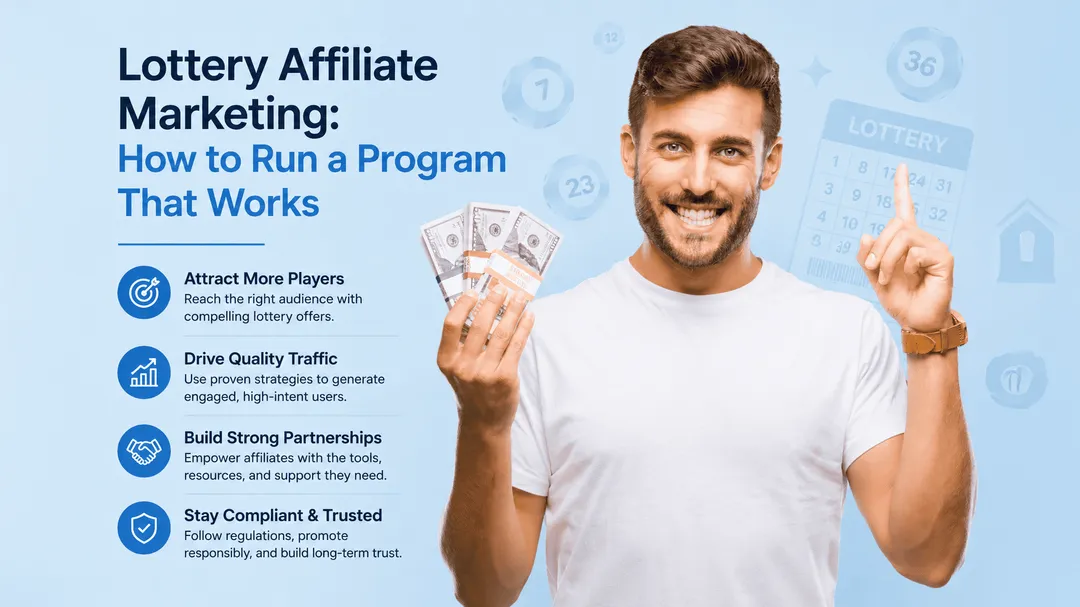
Everyone in iGaming affiliate marketing talks about casino and slots. Lottery? It tends to get left in the corner. Which is a bit odd, because lottery has something most verticals would kill for: a product people already understand, already trust, and already buy without anyone needing to explain what a paytable is.
That makes lottery affiliate marketing a genuinely interesting opportunity, and one that fewer operators are fighting over. So if you run an online lottery and you're thinking about an affiliate program, this is for you. We'll cover what makes lottery different, how the commission models actually work, and how to run a program that doesn't fall apart once you've got more than five partners.
Why Lottery is Different From the Rest of iGaming
Lottery players don't behave like slots players. The appeal is simpler, the sessions are shorter, and the whole thing leans on anticipation rather than fast, repeated play. That changes how affiliates should market it, and how you should structure the program.
A few things stand out:
- Broader appeal. Lottery reaches people who'd never touch a casino. That widens the pool of affiliates who can promote you. This includes lifestyle sites, news outlets, deal aggregators, etc., not just hardcore iGaming media.
- Trust does the heavy lifting. People already get lottery. Affiliates spend less effort explaining and more effort on reach and timing (think big jackpot rollovers).
- Event-driven spikes. Huge jackpots create traffic surges. A good program lets affiliates capitalize on those moments fast.
- Different player value. A lottery player's lifetime value curve looks different from a casino player's, so the commission maths has to reflect that.
If you treat lottery like a casino program with the logo swapped, you'll leave money on the table.
The Main Lottery Affiliate Commission Models
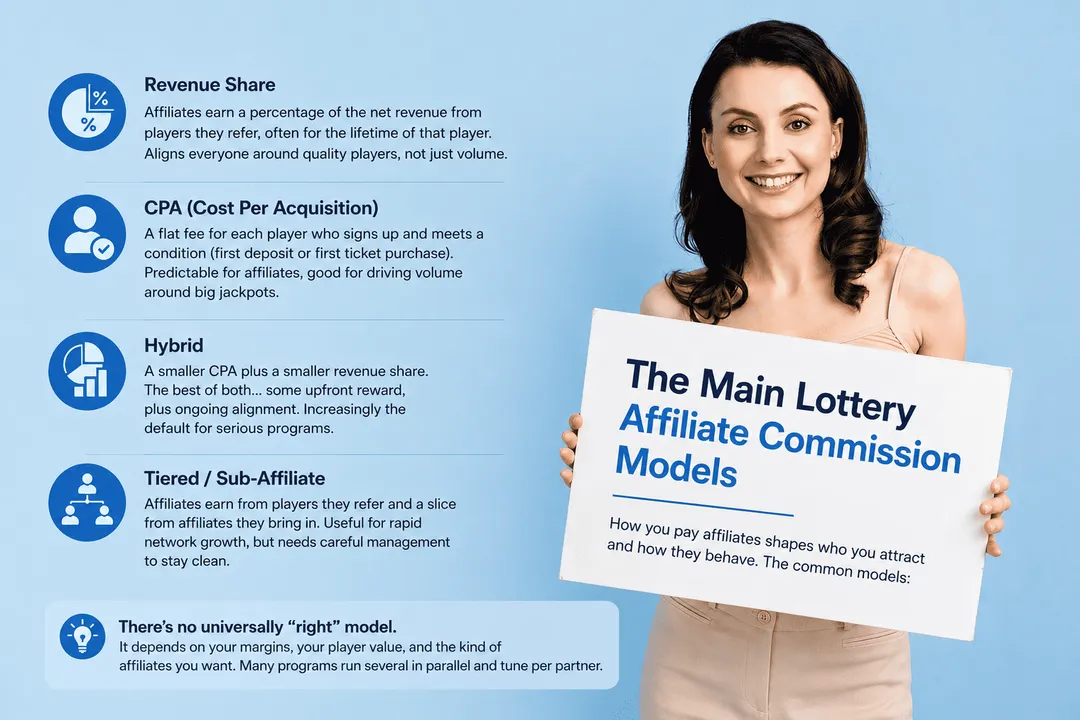
How you pay affiliates shapes who you attract and how they behave. The common models:
- Revenue share. Affiliates earn a percentage of the net revenue from players they refer, often for the lifetime of that player. Aligns everyone around quality players, not just volume.
- CPA (cost per acquisition). A flat fee for each player who signs up and meets a condition (first deposit or first ticket purchase). Predictable for affiliates, good for driving volume around big jackpots.
- Hybrid. A smaller CPA plus a smaller revenue share. The best of both… some upfront reward, plus ongoing alignment. Increasingly the default for serious programs.
- Tiered / sub-affiliate. Affiliates earn from players they refer *and* a slice from affiliates they bring in. Useful for rapid network growth, but needs careful management to stay clean.
There's no universally "right" model. It depends on your margins, your player value, and the kind of affiliates you want. Many programs run several in parallel and tune per partner.
How to Build a Lottery Affiliate Program that Lasts
Setting up is the easy part. Running it well is where most programs wobble. Here's the path that works:
- Nail your terms first. Commission structure, payment timing, what's allowed, what's banned. Clear from day one saves disputes later.
- Recruit beyond iGaming. Lottery's broad appeal means lifestyle and mainstream affiliates can work. Don't limit yourself to the usual casino-media crowd.
- Give affiliates the tools. Banners, landing pages, and copy ready to go, especially around jackpot events when speed matters.
- Track everything in real time. You need to see which affiliates and sources actually drive quality players, not just clicks.
- Pay reliably. Affiliates talk to each other. A program that pays on time and accurately earns a reputation that recruits for you.
- Stay compliant. Lottery is regulated as gambling in most jurisdictions, so responsible gambling messaging, age checks, and geo-rules apply. The age threshold can differ from other gambling, though: in the UK, for instance, the National Lottery minimum is 18 while some society lotteries allow 16. [Verify: confirm the classification and age rules for each territory you operate in.]
Where TheAffiliatePlatform Comes In

Running a lottery program on spreadsheets works right up until a jackpot rolls over and your traffic triples overnight. Then it doesn't.
TheAffiliatePlatform, a sister company of Smartico.ai, built by Mobius Solutions Ltd for iGaming, gives lottery operators one system to run the whole thing. Real-time tracking and analytics show you which affiliates and traffic sources bring players who actually buy and come back. This is vital when jackpot spikes flood you with low-quality clicks alongside the good ones. Custom deal setups let you run revenue share, CPA, and hybrid models side by side, and tune them per partner without rebuilding anything. Multi-level network building supports sub-affiliate structures cleanly if you want to grow that way. And media tools plus A/B testing mean your affiliates can move fast when a big draw is coming, testing which creative converts before the surge hits.
It won't pick your commission model for you. But it turns a program that strains under event spikes into one that handles them, which for lottery is the whole game.
FAQ
Is lottery affiliate marketing worth it compared to casino?
It can be, precisely because it's less crowded and reaches a broader audience. Lottery's mainstream appeal opens up affiliate partners that casino programs can't easily use. The volumes per keyword can be smaller, but competition is lower and trust is higher.
What commission model is best for a lottery affiliate program?
There's no single best one. Hybrid (a smaller CPA plus revenue share) suits many programs because it rewards affiliates upfront while keeping everyone aligned on player quality. The right choice depends on your margins and the affiliates you want to attract.
Do lottery affiliates need to follow gambling advertising rules?
In most markets, yes, lottery is typically regulated as gambling, so responsible messaging, age restrictions, and geo-targeting rules apply, and these extend to affiliate marketing. In the UK, the advertising codes have a dedicated lotteries section, and age limits can differ from other gambling (18 for the National Lottery, 16 for some society lotteries). Confirm the specifics for each territory you operate in.
How do I handle traffic spikes during big jackpots?
Real-time tracking and ready-to-go creative are the two essentials. You need to see quality versus junk traffic as it arrives, and your affiliates need approved assets they can deploy immediately. A centralized platform handles both.
Can non-iGaming sites be good lottery affiliates?
Often, yes. Because lottery is so widely understood, lifestyle blogs, news sites, and deal aggregators can drive quality players (audiences that wouldn't suit a casino pitch). It's one of lottery's biggest advantages as a vertical.
Wrapping up
Lottery affiliate marketing is one of the more overlooked corners of iGaming, and that's exactly what makes it worth a look. A product people already trust, a wider field of potential affiliates, and less competition than the casino scrum.
Get the commission model right, recruit beyond the usual crowd, and make sure your tracking can handle a jackpot-sized rush. Want to see how a program built for iGaming handles all of that? Book a demo with TheAffiliatePlatform today.
Did you find this article helpful? If so, consider sharing it with other industry professionals such as yourself.
Related Guides:
- "commission models" → https://www.theaffiliateplatform.com/en/post/affiliate-commission-models-cpa-revshare-hybrid
- "multi-product commissions" → https://www.theaffiliateplatform.com/en/features/multi-product-commission-structure
- "affiliate platform" → https://www.theaffiliateplatform.com/en/post/affiliate-marketing-platforms-igaming
Need help?
Lets have a chat!
We're here to help you understand how our platform can meet your needs. Schedule a meeting with us, and let's explore how we can drive your success together.
Book a meeting