
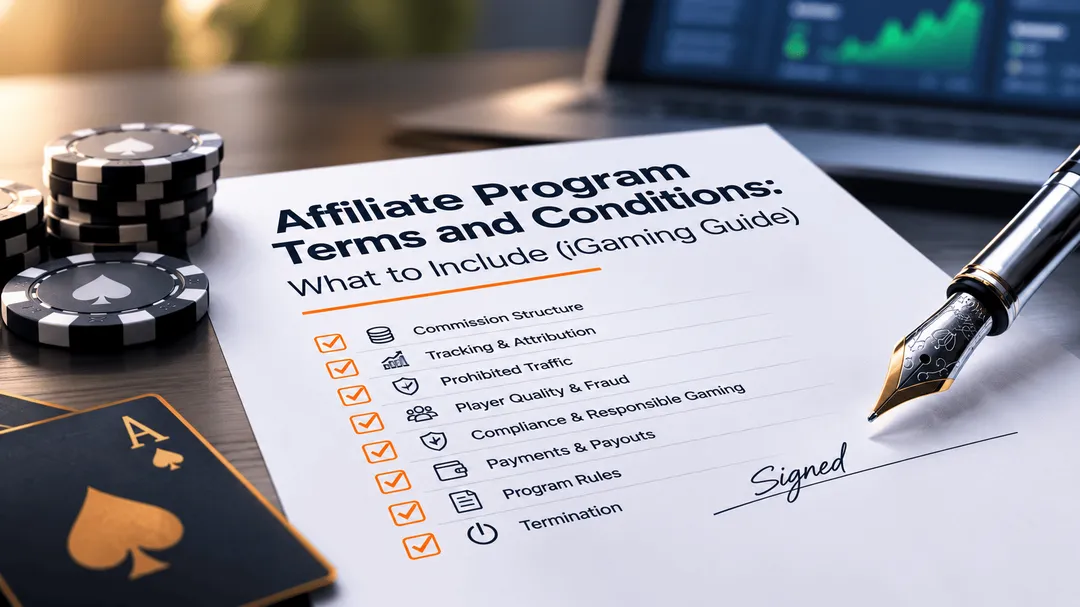
Most operators treat their affiliate terms and conditions as a formality, a document affiliates tick a box to accept and nobody reads again. Then a dispute arrives: an affiliate is bidding on your brand name in paid search, or sending incentivized traffic that never deposits, or claiming commission on players you're not sure they brought, and the terms are suddenly the only thing that decides who's right. If they're vague, you lose the argument or the partner, or both.
In iGaming, the terms carry more weight than in most affiliate programs. You're dealing with real money, regulated markets with rules about how gambling can be advertised, and a partner base that includes sophisticated media buyers who will work the edges of any agreement. Good terms prevent the common disputes before they happen and give you clear ground to stand on when they don't. This is what an iGaming affiliate agreement should contain, section by section, what each part protects you from, and where operators get it wrong.
One thing to be clear about up front: this is practical guidance on what topics your terms should cover, not legal advice, and it isn't a template to copy. Affiliate agreements are legal documents, and the specifics depend on your licensing jurisdictions and how your business is structured. Use this to understand what belongs in the document and to have a more informed conversation with a lawyer who knows iGaming and your markets. Have your actual terms drafted or reviewed by that lawyer before you publish them.
Commission and payment terms
This is the part affiliates read most closely, so it's the part that has to be unambiguous. Spell out the commission model (CPA, revenue share, hybrid), the exact rates or how they're determined, what event triggers a commission (a first-time deposit, qualifying activity, and so on), and precisely how and when payments are made, including the schedule, the minimum payout threshold, and the currency.
The mistake operators make here is leaving definitions loose. "Revenue share" means nothing until you define what revenue it's a share of, gross, net, net of what exactly (bonuses, chargebacks, fees, taxes). Ambiguity in the revenue definition is one of the most common sources of affiliate disputes, and it always surfaces at payment time. Define the terms precisely enough that both sides calculate the same number.
Negative carryover
Decide and state your position on negative carryover, whether a player's net losses to the operator carry forward against an affiliate's future earnings when a revenue-share player wins in a given period. It's a genuine point of contention in iGaming affiliate deals, and affiliates increasingly expect a "no negative carryover" policy, where each month starts fresh.
Whatever you decide, put it in the terms explicitly. Silence on negative carryover is read differently by each side and becomes a dispute later. Many operators offer no negative carryover (often configurable per affiliate or per deal, as TheAffiliatePlatform supports) as a competitive term, but the point is to state your policy rather than leave it unwritten.
Prohibited traffic and promotion methods
This is the section that protects your brand, your compliance standing, and your budget, and it's where iGaming terms need to be most specific. It defines how affiliates are not allowed to promote you.
The big one is paid search and brand bidding. State plainly whether affiliates may bid on your brand terms, and be specific: no exact-match brand keywords, no brand plus modifiers ("[brand] bonus," "[brand] login"), no misspellings, no use of your brand in ad copy or display URLs. Brand bidding is the single most common paid-search dispute, and it's closely tied to direct linking, so if you allow direct linking, your brand-bidding rules matter even more. Getting this clause right prevents affiliates from getting paid for players who were already searching for you.
Beyond brand bidding, spell out the other prohibited methods: incentivized traffic (offering users rewards to sign up), spam email or messaging, misleading or false advertising, cookie stuffing, adult or illegal sites, and any traffic source you don't permit. In regulated markets, add promotion methods that would breach advertising rules.
The mistake here is being too general ("no inappropriate promotion"). Vague prohibitions are unenforceable. The specific ones are what let you actually terminate an affiliate who breaks them and withhold commission on the traffic in question.
Compliance and responsible gambling obligations
Because you operate in regulated markets, your affiliates' promotion has compliance consequences for you. The terms should require affiliates to follow the advertising regulations of the jurisdictions they target: mandatory responsible gambling messaging, age verification and "18+" or "21+" disclaimers where required, restrictions on targeting minors or self-excluded individuals, and any market-specific rules on how bonuses and odds can be advertised.
This matters because a regulator holding you responsible for how your affiliates advertise doesn't accept "the affiliate did it" as a defense. Putting these obligations in the terms, and enforcing them, is part of how you demonstrate you took reasonable steps. The mistake is omitting compliance entirely and assuming affiliates know the rules; many don't, especially smaller ones, and your license is the one exposed.
Prohibited and restricted jurisdictions
State clearly which countries and regions affiliates may not send traffic from, the markets where you're not licensed, where iGaming is illegal, or where you've chosen not to operate. This protects you from receiving (and paying for) players you can't legally accept, and from the regulatory exposure of appearing to market in prohibited territories.
Keep this list current. Markets open and close, and licensing changes; terms that name an outdated set of restricted jurisdictions create risk. This is one of the sections most worth reviewing periodically rather than writing once and forgetting.
Intellectual property and brand use
Define how affiliates may use your brand, logos, trademarks, and marketing materials, and how they may not. Typically this grants a limited license to use approved creatives to promote you, while prohibiting modification of your assets, registration of domains containing your brand, or any use that implies the affiliate is you rather than a partner.
This protects your brand from misuse and from affiliates building assets (domains, social accounts) on your trademark that you can't easily reclaim. Providing approved creatives as part of onboarding and referencing them in the terms keeps brand use consistent and controlled.
Termination and account conditions
Set out how either party can end the relationship, and what happens to pending commissions when they do. Cover the grounds on which you can terminate immediately (breach of the prohibited-traffic rules, fraud, compliance violations), notice periods for ordinary termination, and your right to withhold or claw back commissions earned through activity that violated the terms.
It's also worth addressing dormant accounts, whether and when unused affiliate accounts or unpaid balances below the threshold expire, in line with your jurisdiction's rules on unclaimed funds. The mistake operators make is having no clear termination-for-cause clause, which leaves them paying out on fraudulent or non-compliant activity because the terms didn't reserve the right not to.
Fraud and audit rights
Give yourself the explicit right to investigate suspicious activity, withhold payment during an investigation, and reverse commissions on traffic found to be fraudulent or in breach. iGaming affiliate programs attract fraud, from bot traffic to bonus abuse to misattributed players, and without an audit-and-withhold clause you can find yourself contractually obligated to pay on activity you know is bad. Reserve the right in the terms, and pair it with the monitoring to actually detect the problems.
Liability, confidentiality, and general clauses
The standard legal provisions that a lawyer will handle but that need to be there: limitation of liability, confidentiality (especially around commercial terms and player data), data protection obligations (GDPR and equivalent, given affiliates handle personal data), governing law and jurisdiction for disputes, and the operator's right to amend the terms with notice. These are the sections most clearly in legal territory, and the clearest reason the whole document needs professional review rather than a copied template.
How to write terms that protect you without scaring off good partners
The balance every operator has to strike is between terms strict enough to protect the program and terms reasonable enough that quality affiliates still want to join. A few principles help.
Be clear over clever. The goal is that both sides read a clause the same way. Plain, specific language prevents more disputes than dense legalese, and affiliates trust terms they can actually understand.
Be strict on the things that matter and generous on the things that don't. Firm, specific rules on brand bidding, prohibited traffic, compliance, and fraud are where strictness pays off. Competitive, affiliate-friendly positions on the commercial terms, no negative carryover, fair payment schedules, reasonable thresholds, are where generosity attracts good partners. Getting this the wrong way round, loose on fraud but stingy on payments, drives away the affiliates you want and keeps the ones you don't.
Make them enforceable, then enforce them. Terms you don't act on train affiliates to ignore them. Specific clauses plus consistent enforcement (backed by the reporting and controls to detect breaches) are what give the document real weight.
Keep them current. Regulations change, markets open and close, and new abuse methods appear. Review the terms periodically, particularly the restricted-jurisdictions and compliance sections, rather than treating them as written once.
Set terms you can actually enforce

Good terms are only as strong as your ability to act on them. TheAffiliatePlatform gives operators the controls to enforce what the agreement says, prohibited-traffic and fraud detection, configurable negative carryover per affiliate or deal, approval and manager-assignment rules at registration, and real-time reporting to spot breaches, so your terms are a working policy rather than a document nobody checks.
Built by the team behind Smartico.ai for iGaming operators. Book your demo now to see how it puts your affiliate terms into practice.
FAQ
1. Do I really need formal affiliate terms and conditions?
****Yes. They're the legally binding basis of the relationship and the only thing that resolves disputes over commission, prohibited traffic, or termination. Operating without clear terms means every disagreement is decided by whoever argues hardest, and it leaves your brand and license exposed.
2. What's the most important clause for an iGaming program specifically?
****The prohibited-traffic section, especially the brand-bidding rules, because it's the most common source of disputes and the one most tied to your paid-search costs and brand control. Compliance obligations are a close second, since your license is what's at risk if affiliates advertise improperly.
3. Can I just copy another operator's terms?
****No. Beyond the copyright and enforceability problems, another operator's terms reflect their jurisdictions, their commission structure, and their business, not yours. Use examples to understand what to cover, then have a lawyer familiar with iGaming and your markets draft or review your own.
4. How do I stop affiliates from bidding on my brand?
****Prohibit it specifically in the terms (no exact-match brand terms, no brand plus modifiers, no brand in ad copy or URLs), monitor paid search for your brand terms, and enforce it by withholding commission and terminating repeat offenders. Clear rules plus active monitoring handle most of it.
5. How often should I update my affiliate terms?
****Review them at least annually, and whenever you enter a new market, change your commission structure, or a relevant regulation changes. The restricted-jurisdictions and compliance sections date fastest.
Did you find this article helpful? If so, consider sharing it with other industry professionals such as yourself.
Need help?
Lets have a chat!
We're here to help you understand how our platform can meet your needs. Schedule a meeting with us, and let's explore how we can drive your success together.
Book a meeting