
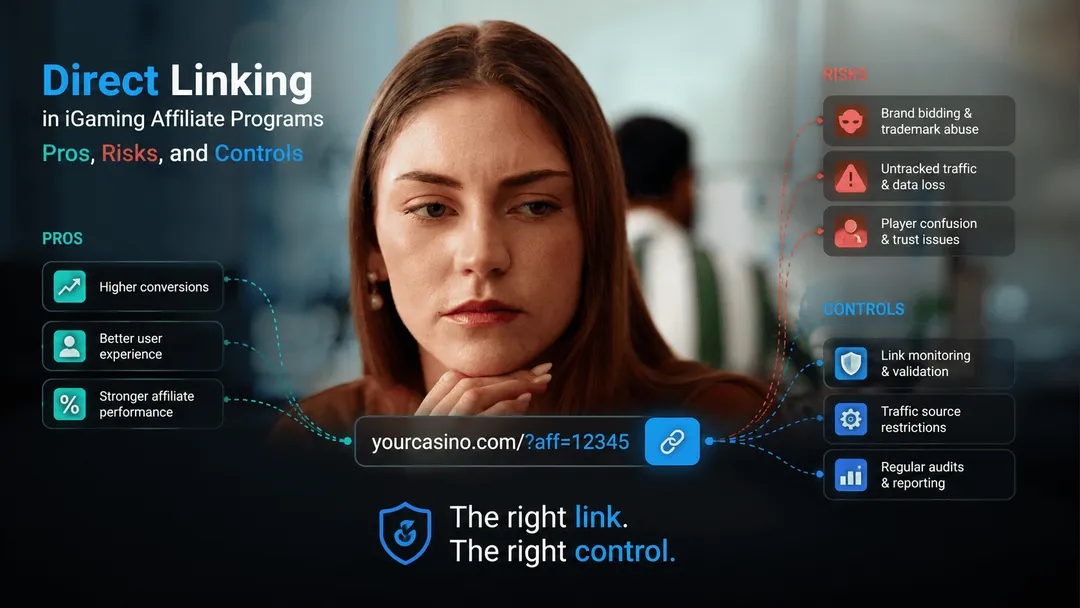
An affiliate you've just signed emails you a request. They want to run paid traffic straight to your registration page. No review site in the middle, no comparison table, no "top 10 casinos" article with your brand at number three. Their tracking link, then your signup form. That's it.
Do you say yes?
It's a more interesting question than it looks, and how you answer it shapes the quality of the traffic you get, how clean your attribution stays, and in some markets whether you stay on the right side of your license. This is what direct linking is, why affiliates keep asking for it, where it helps you, where it quietly hurts, and how to allow it without handing over control of your brand.
What direct linking means
Direct linking is when an affiliate sends traffic straight to your site through their tracking link, without routing it through a landing page or content page of their own first. The player clicks an ad, a social post, or a link, and lands directly on your registration page or a specific offer, with the affiliate's click tracked on the way in.
The alternative, and the default for most content affiliates, is the pre-lander: the affiliate owns a page (a review, a bonus roundup, a comparison) that warms the visitor up and then sends them to you. Direct linking skips that step.
The distinction matters because the pre-lander does work. It filters out idle curiosity, sets expectations, and pre-sells the offer, so the traffic that reaches you is usually more qualified. Direct linking trades that filtering for speed and volume. Neither is automatically better. It depends on where the affiliate's traffic comes from and what you're trying to protect.
Why affiliates want to direct-link
For the affiliate, cutting out their own landing page removes friction and cost. Every extra page in the path loses a percentage of clicks, so sending traffic straight to your offer means fewer drop-offs between the ad and the signup. For affiliates running paid media, where they pay for every click, that efficiency is the whole game: less leakage, more conversions per dollar spent.
It also lets them move fast. An affiliate spotting a trend, a big match, a new game, a market opening, can point traffic at your offer within minutes rather than building and testing a landing page first. Media buyers and social affiliates in particular lean on direct linking because their edge is speed and volume, not content.
So when an affiliate asks to direct-link, they're usually telling you something useful about themselves: they're a paid or social traffic source, not a content site. That's worth knowing, because it tells you which risks to watch.
Where direct linking helps you
The upside for the operator is real, and it's mostly about the affiliates it unlocks. Some of the highest-volume affiliates in iGaming are media buyers and social traffic specialists who don't run content sites at all. If your program only supports content-style promotion, you're closed to that entire category of partner. Allowing direct linking opens the door to them.
There's a conversion argument too. A shorter path can convert better for warm, high-intent traffic. Someone who clicked a specific offer ad already knows what they want, and an extra pre-lander can add friction rather than value. For that kind of traffic, sending them straight to registration is the right call.
And it can produce cleaner intent signals. When there's no pre-lander massaging the visitor, the traffic that converts is closer to its raw source, which makes it easier to judge what an affiliate's channel is actually worth once the players start depositing.
Where it bites
Now the other side, because this is where operators get burned.
The first problem is traffic quality. The pre-lander that direct linking removes was also doing quality control. Without it, you're more exposed to thin, low-intent, or incentivized traffic that clicks through and never deposits, or deposits once and vanishes. Direct-linked traffic needs closer scrutiny on the metrics that matter, registration-to-deposit rate, deposit-to-retention, player value over time, not just the click and signup counts that look healthy on the surface.
The second is fraud. A direct link with your tracking parameters is simpler to abuse than a content funnel. It's easier to point bot traffic, incentivized clicks, or misattributed organic players at a bare offer link than to fake an entire review-site journey. Direct linking doesn't cause fraud, but it lowers the effort required, so programs that allow it need their fraud controls actually running rather than checked occasionally.
The third, and the one that catches operators off guard, is paid search and brand bidding. When affiliates direct-link from paid ads, some will bid on your brand terms, running ads against searches for your casino's name and then direct-linking the click to your offer. From the affiliate's side it looks like conversions. From yours, you may be paying commission on players who were already searching for you and would have arrived anyway, while also competing with your own affiliate in the ad auction and driving up your costs. This is one of the most common disputes in affiliate programs, and it's almost entirely a direct-linking phenomenon.
The fourth is attribution noise. Direct links are easy to share and easy to misfire, so without clean tracking you can end up crediting an affiliate for traffic they didn't genuinely originate. That's both a cost problem and a trust problem when a partner disputes the numbers.
None of these are reasons to ban direct linking. They're reasons to allow it on your terms rather than the affiliate's.
How to allow direct linking without getting burned
The workable position for most iGaming operators is not "yes to everyone" or "no to everyone." It's "yes, under clear rules, and only for partners who earn it." A few controls make that practical.
Write the paid-search rules into your terms and mean them. This is the single most important control. State plainly whether affiliates may bid on your brand terms, and be specific: no exact-match brand bidding, no brand plus "bonus" or "login," no misspellings of your brand, no using your brand in ad copy or display URLs. Brand bidding is where direct linking most often turns adversarial, and a clear rule up front prevents most of it. The affiliates worth keeping will follow it; the ones who won't are showing you who they are.
Judge direct-linked partners on deposit and retention data, not clicks. Because the pre-lander filter is gone, your reporting has to do the filtering instead. Watch registration-to-deposit and early retention closely for these affiliates, and act on what you see. Real-time reporting that shows you FTDs and player value per affiliate, not just clicks and signups, is what makes this possible. If the numbers look thin, you catch it in the first weeks rather than after a payout.
Match the commission model to the traffic. Direct-linked paid traffic carries more quality risk, which is exactly the case for revenue share or hybrid rather than pure upfront CPA. When the affiliate earns as the player generates real revenue, thin or non-depositing traffic costs you far less, and your incentives line up: you both make money only if the players are real. Reserving high upfront CPA for content affiliates with a track record, and steering new direct-linkers toward RevShare or hybrid until they've proven out, protects the budget.
Keep fraud controls live. Automated monitoring for unusual conversion rates, bot-like patterns, and incentivized traffic should be running continuously, not spot-checked. Direct linking is where those controls earn their keep.
Consider earning it as a privilege. Some operators let new affiliates start with content-style promotion or tighter terms, and open up direct linking once the partner has shown their traffic converts and retains. It's a simple way to get the volume benefits of direct linking from partners you trust, without exposing the program to every unknown signup.
So, do you say yes?
Back to the affiliate waiting on your reply. For most iGaming operators the honest answer is yes, but on your terms: clear brand-bidding rules in the agreement, a commission structure that matches the risk of the traffic, reporting that judges the partner on deposits and retention rather than clicks, and fraud controls that are actually switched on. Get those in place and direct linking opens you to some of the highest-volume affiliates in the industry without handing them control of your brand or your budget. Skip them, and it becomes the fastest way to pay for traffic that was never worth anything.
Direct linking isn't the risk. Allowing it blind is.
A few specific questions
1. Is direct linking allowed in iGaming affiliate programs?
****It's allowed if the operator permits it, and most do, under conditions set out in the affiliate terms. The important limits are usually around paid search and brand bidding rather than the practice itself.
2. Does direct linking work on mobile?
****Yes. Direct links work across mobile and desktop, and mobile is where a lot of paid and social direct-linked traffic originates, so mobile-friendly offer and registration pages matter for this traffic in particular.
3. Is direct linking the same as brand bidding?
****No. Direct linking is sending traffic straight to your offer without a pre-lander. Brand bidding is buying ads on your brand's search terms. They often occur together, an affiliate bids on your brand and direct-links the click, which is why they get confused, but they're separate things, and brand bidding is the part you most need to govern in your terms.
4. Should I require affiliates to use a landing page instead?
****Not as a blanket rule. Requiring pre-landers improves traffic quality but closes you off to media buyers and social affiliates who drive real volume. A better approach is to allow direct linking under clear terms and let your reporting and commission structure manage the quality risk.
5. How do I stop affiliates bidding on my brand?
****Spell it out in your terms with specifics (no exact-match brand terms, no brand plus modifiers, no brand in ad copy or URLs), monitor paid search for your brand terms, and enforce it. Clear rules plus active monitoring prevent most of it, and make the rest easy to act on.
Run direct linking on your terms, not theirs

TheAffiliatePlatform gives operators the controls that make direct linking safe to allow: real-time reporting on FTDs and player value per affiliate rather than just clicks, flexible commission structures so you can match the deal to the traffic, and fraud detection running in the background.
Built by the team behind Smartico.ai for iGaming operators, it's designed for exactly these decisions. Book a demo to see how it handles affiliate traffic quality in practice.
Did you find this article helpful? If so, consider sharing it with other industry professionals such as yourself.
Need help?
Lets have a chat!
We're here to help you understand how our platform can meet your needs. Schedule a meeting with us, and let's explore how we can drive your success together.
Book a meeting